
For whom the T. Rex roars
By Steve Sabatka
For the TODAY
Last Spring, not long after my dad died after a long illness, my Walterville brother sent me some old family photographs, prints, physical media, as the kids say. One was an old-style square, white-border snapshot, taken with one of those sorry Instamatic cameras. But the image was compelling. As I held that photo at arm’s length (because I have to these days), happy memories came to mind. So did the lyrics of an old song:
If you ever plan to motor west,
Travel my way, take the highway that is best.
There was a time when families could pack up their Ford Pintos and VW vans, fuel up on el-cheapo gas, and explore, Kerouac-style, the wonders of Roadside America: the World’s Largest Ball of Twine, the Only Hand-Dug Oil Well, and Oregon’s own Vortex House of Mystery.
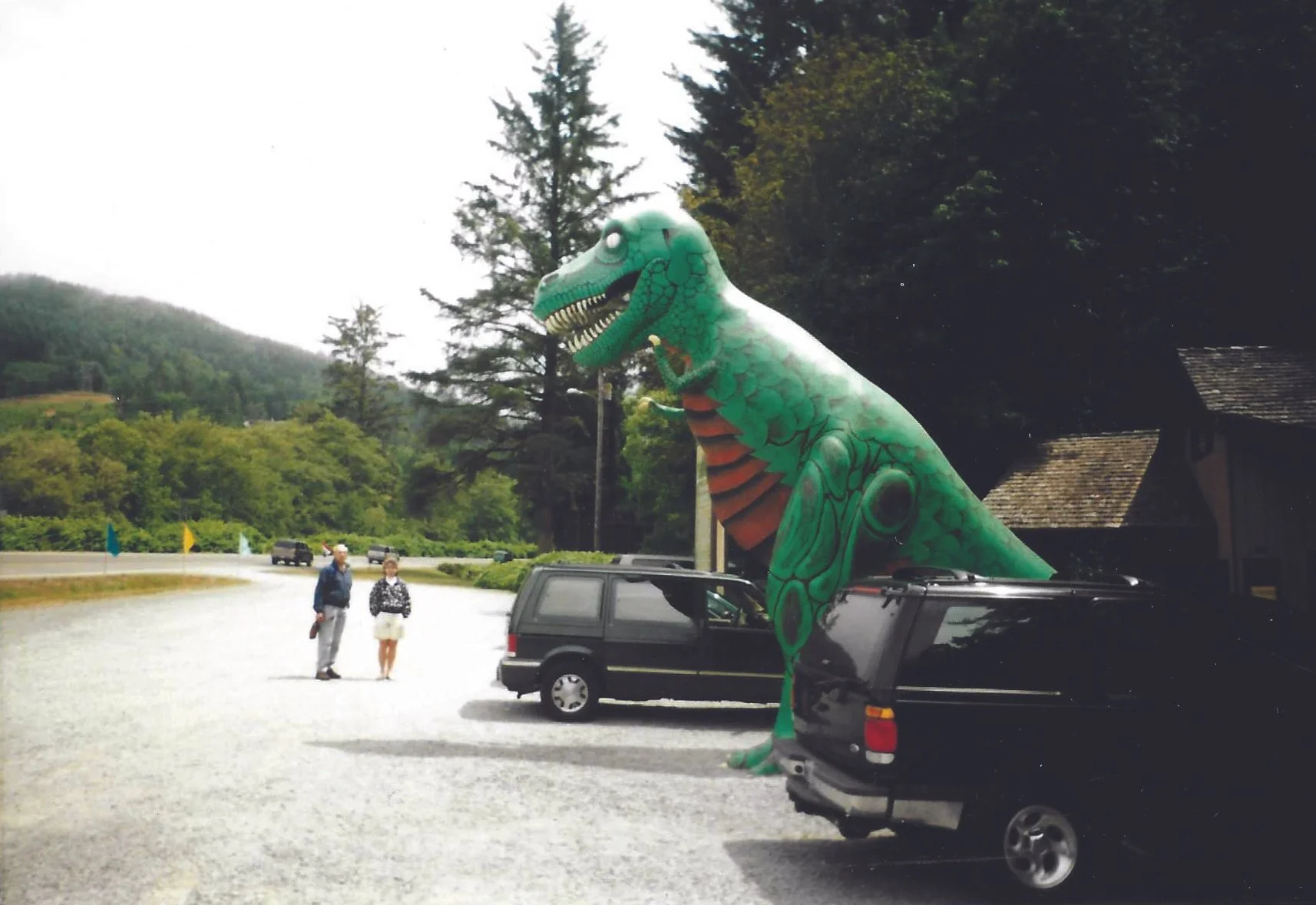
Of course, the true kings of the road were dinosaurs, life-sized, usually made of concrete or fiberglass, and reasonably accurate to the scientific consensus of the time. Those edificial beasts reigned from Maryland to right here in our Oregon Coast rainforest, Port Orford, to be exact, where, in 1955, a mad genius named Ernie Nelson opened a scratch-built primordial bestiary of 23 extinct specimens, surrounded by Sitka spruce and other wild plants. Out front, a full-scale Tyrannosaurus Rex grinned down on Pacific Coast Highway. Mr. Nelson named his attraction Prehistoric Gardens.
Dad took that photo. It’s dated 1972, when I was 12, and shows my Tigard brother and me standing between Ernie’s T. Rex and our family station wagon with the fake wood paneling. It's a Norman Rockwell image if ever there was one. I was a junior-league paleontologist of the Roy Chapman Andrews school, the pure faith, believing with all my sixth-grade heart that dinosaurs were roaring B-movie badasses and featherless as bowling balls.
Saurian statues were a safe escape from real-world fears: a global food shortage, the Munich Massacre, and the shootings at Kent State. The war in Vietnam threatened to go on forever, and it seemed likely that I would get drafted and sent off to a jungle of punji sticks and tigers and silver canisters of napalm spinning down from the Indochina sky. And even if I survived the war, scientists predicted that the Earth was cooling and that a second Ice Age was fast approaching.
Time keeps on slippin', slippin', slippin'
Into the future.
Years went by. The Vietnam War finally ended. Famine, genocide and disease flared around the planet, which, according to the new orthodoxy, is heating up now. I graduated from high school and then college. I began a teaching career. There were other events, complications. Decades passed. So did loved ones, good friends. And, tragically, heartbreakingly, ten of my students.
I retired from teaching, called it a career, at 64. Now I had time on my hands and questions that needed answers. One morning, just about the same time that first period would start, I heard an ominous chorus in my mind’s ear: muffled hisses and whisper-snarls from a savage, bygone age. Then it hit me, what better place to reflect on life and mortality than a Mesozoic rain forest? So, more than 50 years after that first visit, I resolved to return to Prehistoric Gardens to find some kind of mountain top, Obi-Wan wisdom, some Universal Truth that would guide and sustain me for the rest of my days.
I couldn’t find a ’70s-era station wagon on such short notice. The best I could do was a friend’s 2023 Hyundai Palisade. Still, she was a sturdy craft with sound lines and brand-new Les Schwabs and sure to survive a voyage into the Dawn of Time and back.
The first hour or so of the trip was exhilarating. The sun was bright in the morning sky, and I could feel my Vitamin D and serotonin levels rising. Seagulls followed without dive bombing my friend’s SUV. To my west, Steinbeck’s “home ocean” was blue and smooth, with white foam marbling closer to shore. To the east, the rocky cliffs and wind-gnarled shore pines reminded me of Japanese woodblock prints I had seen.
Every epic trip needs a soundtrack, so without looking, I grabbed a random CD from the center console, not knowing my friend’s musical taste or what to expect. What song, what symphony would be appropriate for a sunny drive along US 101?
“Ride of the Valkyries” blasted out of the speakers, creating an epic, operatic buzz. I started driving a little too fast and laughing out loud like Robert Duvall in “Apocalypse Now,” so I hit pause and cruised on, observing the three Cs of safe driving: Care, Caution and Courtesy.
Slowly, almost imperceptibly, the road arced inland, away from the ocean and the sunlight and into the forest. The air cooled, turned misty. Doug fir and spruce trees began to close in on both sides and above me, eclipsing the sunlight and depriving me of any heliacal benefits. I recalled Conrad’s “Heart of Darkness,” and Marlow’s journey “back to the earliest beginnings of the world, when vegetation rioted on the earth and the big trees were kings.” And like Marlow, I could feel myself drawn, compelled by some aboriginal presence, some asphalt-paved undertow. Seagulls turned into crows, ravens, maybe. Things were getting Karl Jung-trippy. Cool by me.
Trippier yet, I began to see, with increasing frequency, Bigfoot his own self. At first, I thought it was just my imagination playing tricks on me, or wishful thinking. But no, there he was, in the form of chainsaw carvings, painted murals and advertisements for building supplies. The old boy seemed to be guiding me like a fur-robed priest from some neolithic cult, pointing the way to healing satori with pine-knotted fingers.
The Bigfoot sightings ended, and the ravens went away. And I mean all of a sudden. It was like a scene in a scary movie where the crickets stop chirping. You know that something is about to happen.
Sure enough, just ahead of me on the right, 20 feet high, the Tyrant King of dinosaurs came striding out of the rain forest on legs of concrete and rebar, just like he had back in ‘72.
I parked, got out, and stretched a bit. I was 12 again, safe with my reptile friends. And nobody I knew had died.
I stood at the feet of that great colossus, looked up. And up. The Tyrannosaur, backlit by the weak sun, towered over me in a featureless, midnight silhouette, with white-gray clouds moving behind it, like a time-lapse effect.
I listened for answers, enlightenment, for the good news that would set me free.
Nothing. No hissed revelations or Cretaceous insight.
A logging truck rumbled by, headed south to California, and I smelled fresh-cut red cedar.
Still game, I stepped out of the chill, beast-shadow. From this new angle, the Rex appeared worn, weary, lost, especially in the eyes. I had to shake heartrending memories of visits to retirement homes and hospitals.
My mood sank. The beast that Ray Bradbury described as “the most incredible monster in history” was just a relic, now, a withered, weathered shadow of its former, earth-shaking greatness, a T. Rex in winter. It was like seeing Elvis in that last, puffy-faced concert in Omaha, or John Wayne’s Oscar acceptance speech in 1979. The horror. The horror. The realization:
I am the T. Rex,
Goo goo g'joob
And the asteroids of extinction (great name for a band) were on their way. This was not the beatific awareness I wanted.
Disheartened, I bought a ticket (without asking for a senior discount) and went into the park, into the archetypal woods, to ponder and process. I followed that gravel path for the second time in my life: Triceratops. Trachedon. Pteranodon. Sword fern. Beaked moss. Seaside Bone Lichen. All the beasts and the flora had been well-maintained. Everything was exactly as I remembered.
I was relieved. Maybe things weren’t as dire as I thought. All the Tyrannosaurus and I needed was some minor patching up, a little senior maintenance, and we’d be our old selves again. Relief turned instantly to horror. I paused, stared into the yellow-green, split-pupil eyes of the Stegosaurus. “Did you bring me all this way to tell me to stock up on Grecian Formula and Rogaine?”
Confused and tired, I went back to the Hyundai, thinking I might pick up some Centrum Silver on my way back to the real world.
What occurred next actually happened. I promise you.
I saw a man about my age, a grandad, and his grandson taking pictures of each other, one at a time, with the Tyrannosaurus. I offered to take their picture, both of them in the shot with the Rex. They were game and grateful. I needed help with their digital camera. (“Where’s the viewfinder on this thing?”) But eventually, I snapped off a few good angles. Norman Rockwell strikes again.
I couldn’t help but wonder if the three — well, four of us, if you count the Tyrannosaurus — had been summoned for this roadside photo op. I wanted to think so, but at the same time I realized, deep in my swollen prostate, that life just isn’t up to me, and the best I can do is listen to the voices, the songs.
“Take my advice,” I said to the boy. “Print those pictures and hold on to them. Lock them away. Hire a vicious guard dog with big teeth to keep them safe.”
The boy nodded. “They’re in the Cloud, forever.”
I didn’t know what he meant, but the Cloud sounded safe in a mystical sort of way, so I didn’t push it.
It started raining, like curtains coming down after a play, because that’s what happens in the rainforest. It was time to return to the 21st Century.
I am glad I made the trip, and I’m trying to pay attention to all the hints and whispers without bending them to what I want them to mean. In other words, I’ll never look a gift-Trex in the mouth again.
Sorry. I didn’t mean to close on such a cornball note. So, I’ll end this story with some ambiguous and often misheard lines from David Bowie:
Ch-ch-ch-ch-changes (Turn and face the strange)
Ch-ch-changes, just gonna have to be a different man
Time may change me
But I can't trace time