
The Dream team
Sweet dreams are made of music, poetry and drama in Lincoln City
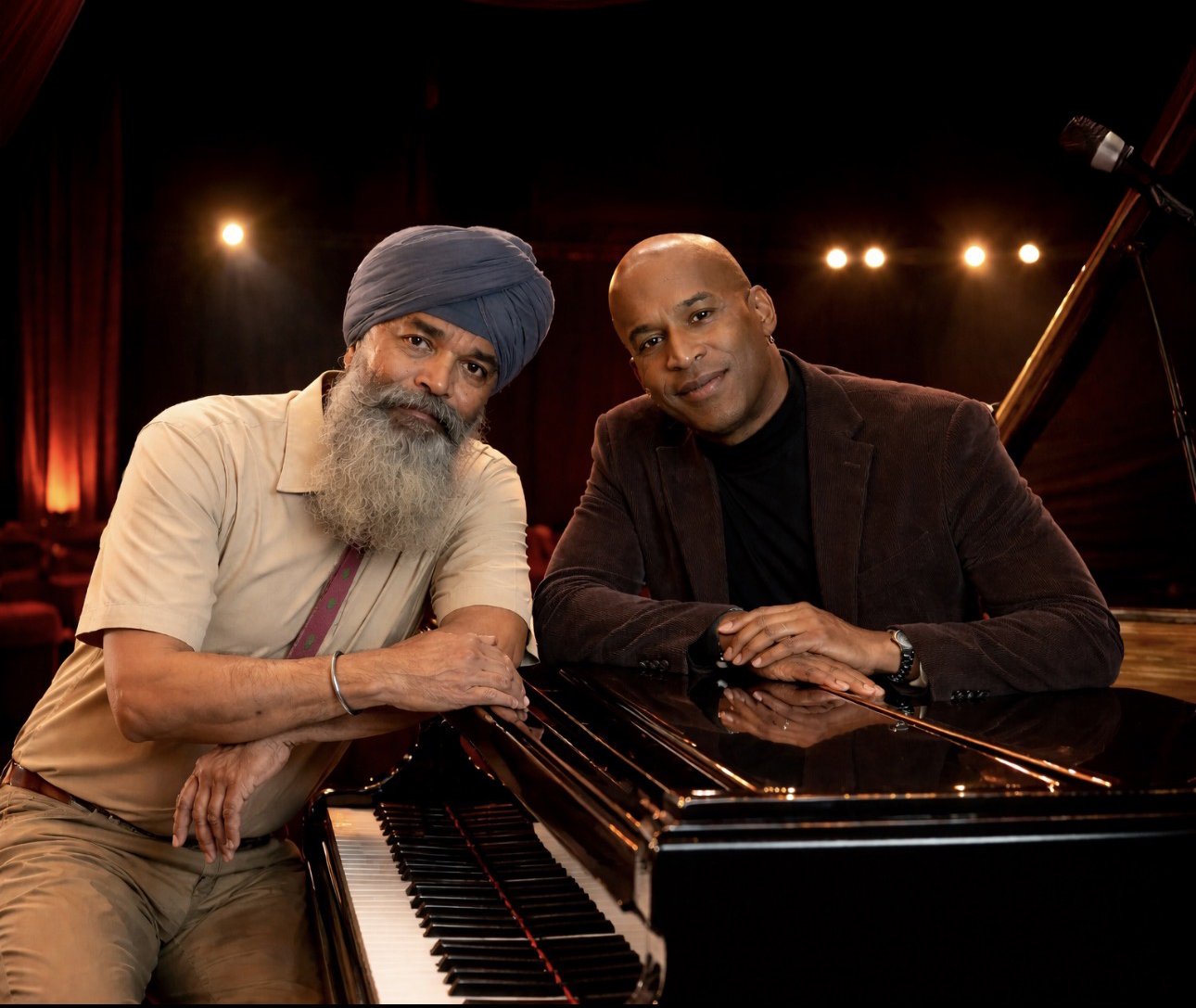
Jasnam Daya Singh and Darius Wallace
By Eliot Sekuler
For the TODAY
At a moment when the concept of the classic American dream is being called into question, Siletz Bay Music Festival will present a new theatrical and musical work that makes a case for the importance of holding on to hope in difficult times.
“Hold Fast to Dreams, the Poetry of Langston Hughes,” a jazz-infused theatrical production incorporating the writings of Langston Hughes, will receive its world premiere at the Lincoln City Cultural Center on Friday and Saturday, May 29 and 30.
Conceived by actor, poet and playwright Darius Wallace and composer and pianist Jasnam Daya Singh, the production blends spoken drama, poetry and original jazz-based music into a meditation on dreams deferred — and dreams sustained.
Wallace performs all of the dramatic roles, while a quintet led by Daya Singh performs the original score. Wallace describes the production as “a celebration of language, humor, love, rage and wisdom in community.”
Few American writers explored the tension between aspiration and reality more deeply than Hughes. A central figure of the Harlem Renaissance, Hughes chronicled the lives of working people, musicians, dreamers and struggling families with a voice shaped by blues, jazz and everyday speech. Throughout his prolific career, he published poetry, plays, novels and journalism, producing 35 books, including 16 volumes of poetry.
“Langston Hughes’ work has always remained significant, but we’re living in a time when it feels even more relevant,” Wallace said. “There are parallels between the late 1940s and 1950s, when Hughes was at the height of his career, and what we’re experiencing today.”
Hughes’ poetry ranged from hopeful and celebratory verses to work that was sharply critical of racism, inequality and the crushing of human ambition. His commitment to portraying Black life in America with honesty and dignity — combined with his political leanings and focus on working people — made him a target during the anti-communist fervor of the McCarthy era. Ultimately, he endured that period of political repression and continued producing some of his most influential work right through the year of his death in 1967.
“People who have dreams or aspire to a more secure life may find those hopes crushed by circumstances beyond their control,” Wallace said. “Langston Hughes’ poetry delivers hope amidst warnings, encouragement, tragedy and humor. His characters reflect real people, and his ideas are universal. They speak to the truth of who we are as human beings.”
Wallace built the production around the characters embedded within the poems themselves, using the voices of those characters to weave a continuous dramatic narrative.
“The beauty of Langston Hughes was his prolific output,” Wallace said. “The first challenge was deciding what story to tell.”
As he immersed himself in Hughes’ work, Wallace began noticing recurring themes surrounding dreams, the deferral of dreams and the ways people cope when life diverges from their expectations.
The narrative follows characters confronting disappointment, compromise and survival.
One sequence centers on a Black clown forced to adopt a comic persona in order to make a living, reflecting the pressure many Black performers historically faced to suppress their authentic selves to survive professionally. Other scenes explore the moments of joy and heartbreak and the necessity of maintaining resilience in the face of adversity.
“Amid all of it — success or failure — the dream remains alive,” Wallace said.
Based in Memphis, Wallace previously collaborated with Portland-based Daya Singh on “My Words Are My Sword,” a multidisciplinary work commissioned by the Portland Chamber Orchestra in 2020 and presented in 2024 by Siletz Bay Music Festival. The success of that production established the creative partnership that led to “Hold Fast to Dreams,” a partnership that required a close collaboration despite their locations thousands of miles apart.
For Daya Singh, the challenge was crafting music that would enhance the emotional resonance of the poetry, but would avoid competing with Hughes’ verse.
“As a composer, one of the challenges was ensuring the emotional content of the poems converged with the emotional content of the music,” he said. “Sometimes the best way to support a poem was not to have music at all.”
Unlike a traditional concert setting, Daya Singh said the score functions as part of the
dramatic storytelling, more akin to musical theater while still rooted in jazz traditions.
Despite Hughes’ association with the Harlem Renaissance, Daya Singh intentionally avoided limiting the score to the sounds of the 1920s and 1930s.
“My compositions are informed by that era, but they also draw from a variety of musical genres,” he said. “Many pieces are swing-oriented with jazz and blues elements, but not every poem becomes a blues song.”
Asked what he hopes audiences take away from the performance, Wallace returned to the production’s central theme.
“I hope people realize it’s never too late to dream or pursue what ignites their passion,” he said. “The only time it won’t happen is if they stop trying.”
Performances of “Hold Fast to Dreams” are scheduled for 7:30 pm on Friday, May 29, and 2 pm on Saturday, May 30. A reception will follow the Friday evening performance. For more information and to purchase tickets, priced at $30, $10 for students, go to SiletzBayMusic.org or call 541-264-5828.