
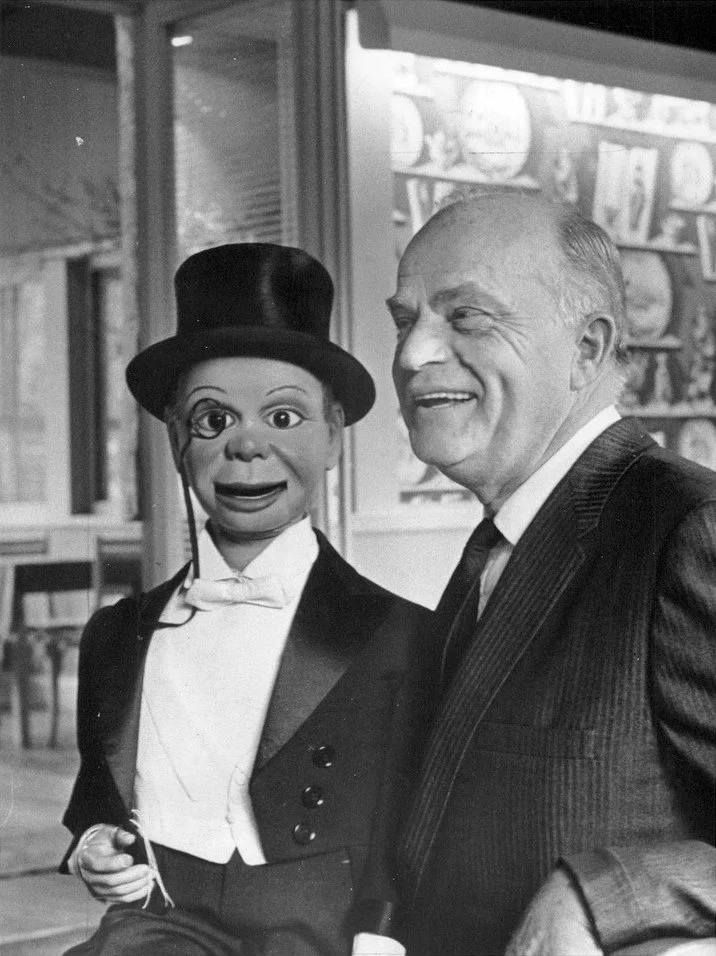
Comedian Edgar Bergen with his dummy, Charlie McCarthy
By Steve Sabatka
For the TODAY
(For Adam Scarberry, friend and history teacher. When I told Adam this story, he remarked, in his usual succinct way, “Very Oregon.”)
Eighty-four years ago, during the first week of December 1941, the number one song in America was “Chattanooga Choo Choo” by Glenn Miller and his orchestra. Very few Americans had ever seen a television. The most popular radio performer was Charlie McCarthy, a wisecracking ventriloquist dummy. The nation was still in the grip of the Great Depression. The 19th Amendment, guaranteeing women the right to vote, was just 21 years old. The Civil Rights Act was 22 years away.
Christmas was coming. In the spirit of the season, a civilian steam freighter, the SS Muana Ala, was on her way to Naval Station Pearl Harbor, Hawaii, packed with 10,000 frozen turkeys, 3,000 frozen chickens, thousands of steaks, tins of almond roca candy, and 60,000 Christmas trees, all intended to make Christmas a little easier for Americans stationed far from home.
Tensions between the US and the Empire of Japan were at an all-time high due to Japan’s aggression in China and America’s subsequent oil embargo. A Japanese military strike seemed imminent somewhere in the Pacific, and the Dutch East Indies, Singapore and the Philippines were the most likely targets. Hawaii seemed safe since the Japanese Home islands were so far away.
But the strategists were wrong. On December 7, Japan attacked Pearl Harbor by sea and air at 7:55 am. The offensive lasted just under two hours. Two thousand four hundred Americans were killed, including 250 women and 11 children. The USS Arizona was sunk and remains at the bottom of the harbor to this day, along with the remains of hundreds of her sailors who were trapped alive below decks. 64 Japanese military personnel died. One Japanese sailor was captured.
Fortunately, the Muana Ala was still several thousand miles away. The Christmas mission was scrubbed. The ship came about and proceeded to the closest deepwater port, our very own Astoria, where the Columbia River Bar is known as one of the most dangerous crossings on Earth. The captain ordered radio silence to avoid enemy submarines.
On December 8, America declared war on the Empire of Japan. As night fell, local authorities all along the Western Seaboard instituted mandatory blackouts. Running silent, the Mauna Ala didn’t get the word and ran aground on Clatsop Spit, not far from the wreck of the Peter Iredale. None of the crew was injured, but much of the holiday cargo, turkeys, steaks, and Christmas trees, went overboard and into the drink.
Local citizens, still reeling after the surprise attack on Hawaii and on the lookout for Japanese planes, ships and submarines, saw a shadowy shape looming just beyond the breakers. They assumed another assault was underway. Every all-American patriot came running down to the beach, armed to the teeth with hunting rifles, BB guns and pitchforks, ready to defend the homeland. They watched. They waited.
When fir trees, wrapped tight with baling wire, started drifting to shore, dark and quiet and seemingly well organized, the defenders assumed them to be Japanese assassins, bent on destroying our way of life. Shots were fired. Christmas trees were dispatched. But then, as turkeys and steaks and other flotsam came bobbing in, cooler heads prevailed. It seemed unlikely that Yamamoto had weaponized almond roca.
The Battle of Clatsop Spit ended at sunrise. The crew of the Muana Ala was rescued by the Coast Guard sailors stationed at Point Adams. The entire West Coast breathed easier.
But in the months and years ahead, the Japanese military would actually target the Pacific Coast and Oregon.
September 1942: Nobuo Fujita, flying a seaplane above Brookings, dropped four 170-pound fire bombs in an attempt to set the local woods ablaze. Due to the typically damp, rainy weather on the Oregon Coast, locals brought the fires under control.
May 1945: A church group came upon an incendiary device that had traveled the Pacific Jetstream from Japan to North America, landing in a pasture near Bly. When a child touched the device, it exploded, killing five children and their pregnant Sunday school teacher. Authorities kept the incident under wraps to avoid panic.
September 1962: The city fathers of Brookings invited Nobuo Fujita to return to Brookings as a gesture of reconciliation. Fujita returned to Brookings several times in the ensuing years, was made an honorary citizen and Ambassador of Goodwill, and planted a Redwood tree in the very forest he had bombed during the war. Today, the 400-year-old ancestral sword Fujita carried during the war is on display at the Brookings Public Library. Fujita died in 1997.
Note: I did my best to get the details right, but accounts differ, and many historical questions remain unanswered. One admittedly minor mystery still haunts me: How could a radio show starring a ventriloquist and a wooden dummy be so popular? Wouldn’t you need to see the act to know if it’s any good?