
Good vibratos
Conductor Johann Stuckenbruck takes the reins at Siletz Bay Music Festival
By Eliot Sekuler
For the TODAY
Mei-Ting Sun, artistic director of Siletz Bay Music Festival, speaks rhapsodically about the festival’s new conductor.
“He’s extraordinarily talented, very personable and a perfect fit for our festival,” said Sun, who first encountered Johann Stuckenbruck while attending a performance of the opera, “Hansel and Gretel” at London’s Royal Academy Sinfonia. “He was very, very good.” Critics agreed and Stuckenbruck’s work with the opera drew rave reviews. “Stuckenbruck’s conducting, impressively, seemed very much of a piece with the seriousness of the production.” wrote critic Mark Berry, echoing the opinions of others who have praised the young conductor’s ability to skillfully bring orchestras into synch with his interpretations of the music.
Stuckenbruck will lead the Siletz Bay Music Festival orchestra in two very ambitious programs taking place on the festival’s final two nights at Chinook Winds Casino Resort, Saturday and Sunday, Aug. 23 and 24. He’ll also direct the woodwind quintet in a free afternoon concert of Prokofiev’s iconic kid-friendly “Peter and the Wolf,” at Lincoln City’s Regatta Park Bandshell on Saturday, August 23.
Reached at his hotel room in Scotland, where he was conducting an orchestra at the Edinburgh International Festival, Stuckenbruck, who studied the double bass before pursuing his conducting career, discussed his musical approach, his influences and his journey through the conducting field.
Stuckenbruck was born into a musical family and, after switching to double bass from his earlier studies on cello, his pianist father recommended he study conducting to deepen his ability to perform with an orchestra.
“He suggested that it would be a means of learning how to respond to the conductor’s gesture,” Stuckenbruck said. “He said I’d gain an understanding of what the conductor was offering and how I could respond as a player.”
The young musician took that advice and it “snowballed” from there.
“As much as I loved playing the bass, I felt I had found a way of making music that suited me.”
Among the conductors he admired was the much-esteemed music icon, Zubin Mehta, who had also studied as a double bass player.
“When I listened to Mehta, I was struck by the choices he made in establishing a sense of precision, of clarity,” said Stuckenbruck. “He had such good taste in his choices, I just had a fascination with the way the conductor helped develop the sound of the orchestra and I listened to a lot of old recordings to hear the choices they made.”
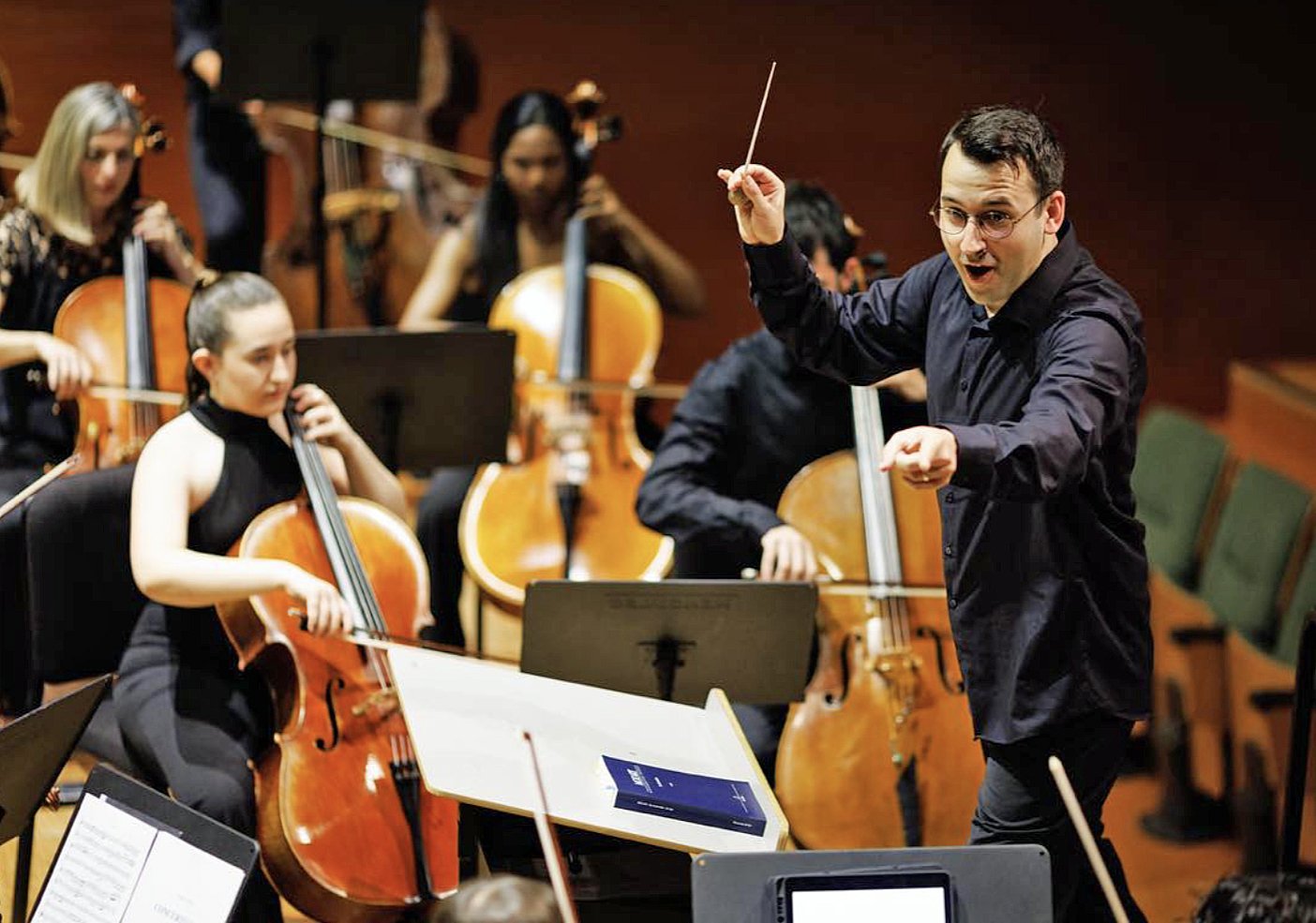
For non-musicians, the role of the conductor in shaping an orchestra’s sound can seem mysterious. The gestures of the baton, the process of establishing a tempo, the way in which body language helps shape the music can be difficult to discern. The key concept is that the notes written upon a printed page leave considerable room for interpretation. The conductor’s task involves forming an artistic vision for the piece, for establishing and maintaining the tempo, signaling dynamics of each passage’s volume and establishing how all the pieces fit into the musical puzzle that the score presents.
Musicians relate how a great conductor’s inspiring presence can elevate an orchestra to its fullest potential. Along with hand motions and the movement of the baton, conductors employ various communication techniques, including expressive gestures, facial expressions and body language, all helping to elicit the desired musical nuances, evoke an emotional response and guide the orchestra in delivering a compelling performance.
The Siletz Bay Music Festival programs that Stuckenbruck will conduct include very diverse pieces of music. The festival finale, “Sounds of the Americas,” features four very different musical views of America, including two of the most famous orchestra works of the 20th Century, Copland’s “Appalachian Spring” and Gershwin’s “Rhapsody in Blue,” both of which drew upon folk-based musical themes to arrive at very different musical impressions of America. Added to that program is Portland-based composer Nancy Ives’ new piece inspired by the Native American experience, “The Spirit of the Columbia” and Bernard Herrmann’s famous “Psycho Suite,” which played a key role in helping filmmaker Alfred Hitchcock terrorize movie audiences around the world.
At Saturday’s “A Night at the Symphony” concert, Stuckenbruck will lead the orchestra and guitar virtuoso Georgii ‘Jojo’ Dimitrov in Spanish composer Joaquin Rodrigo’s famous “Concierto de Aranjuez” and in the difficult Richard Strauss suite, “Der Burger als Edelmann.” (“The Bourgeois Gentleman.”) It’s a piece he’s never conducted before and one that he always wished to perform. Stuckenbruck said he considers Strauss, along with Brahms and Mahler, as being composers who resonate most strongly with his musical sensibilities.
Those planning to attend the August 23 “A Night at the Symphony” concert will have the opportunity to hear Stuckenbruck and Mei-Ting Sun discuss the music and answer questions at a pre-concert talk planned for 6:30 pm in Chinook Winds Casino Resort’s Chetco room.
For more information and to purchase tickets, go to SiletzBayMusic.org or call 541-264-5828.